
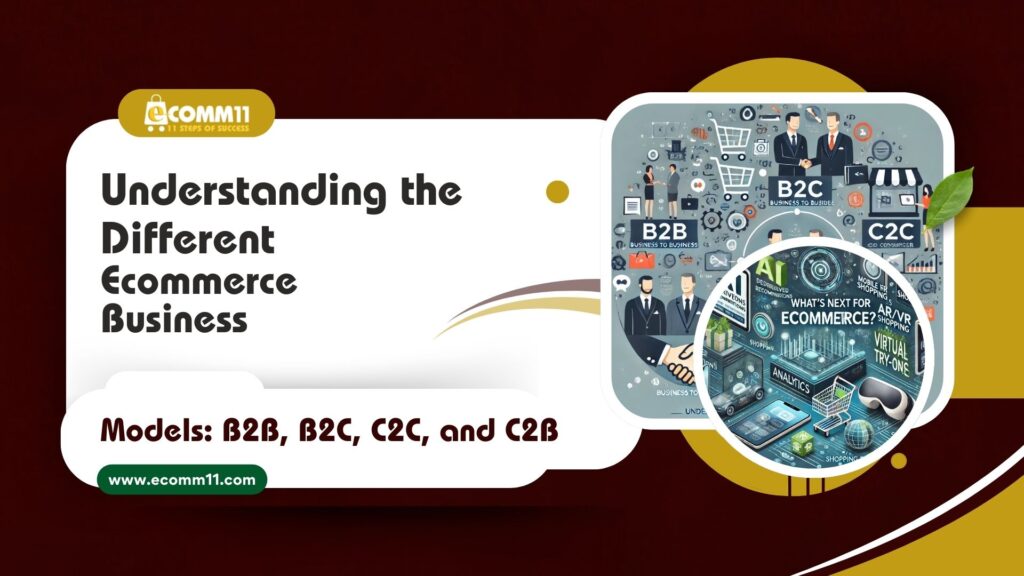
The ecommerce industry has transformed the way businesses and consumers buy and sell products and services. From online marketplaces and brand websites to freelance platforms and wholesale portals, ecommerce now supports a wide range of business models.
However, not all ecommerce businesses operate in the same way.
Some companies sell directly to consumers, while others sell to businesses. Some platforms connect individual buyers and sellers, while others allow individuals to offer services to companies.
These different approaches are known as ecommerce business models.
Understanding the differences between B2B, B2C, C2C, and C2B ecommerce models can help entrepreneurs, startups, brands, and sellers choose the right strategy for growth.
In this guide, we’ll explain each ecommerce business model, its advantages, challenges, real-world examples, and how to determine which model is best suited for your business.
What Is an Ecommerce Business Model?
An ecommerce business model defines how products or services are bought and sold online.
It determines:
- Who is selling
- Who is buying
- How transactions occur
- How revenue is generated
- How customer relationships are managed
Choosing the right ecommerce business model impacts:
- Marketing strategy
- Pricing structure
- Customer acquisition
- Operations
- Profitability
- Long-term scalability
Before launching an ecommerce business, it is important to understand which model aligns best with your goals and target audience.
Overview of Major Ecommerce Business Models
The four primary ecommerce business models are:
| Business Model | Full Form | Seller | Buyer |
| B2B | Business to Business | Business | Business |
| B2C | Business to Consumer | Business | Individual Consumer |
| C2C | Consumer to Consumer | Individual | Individual |
| C2B | Consumer to Business | Individual Consumer | Business individual |
Each model serves a different purpose and operates differently.
Let’s explore them in detail.
What Is B2B Ecommerce?
Definition
B2B (Business-to-Business) ecommerce refers to transactions where one business sells products or services to another business.
Instead of selling directly to end consumers, companies supply products, raw materials, software, or services to other organizations.
Examples include:
- Manufacturers selling to distributors
- Wholesalers selling to retailers
- Software companies selling to businesses
- Packaging suppliers serving brands
Examples of B2B Ecommerce
Common examples include:
- Wholesale marketplaces
- Industrial suppliers
- SaaS software providers
- Business procurement platforms
A manufacturer selling bulk products to retailers is a typical B2B ecommerce example.
Advantages of B2B Ecommerce
Higher Order Values
Businesses typically purchase products in larger quantities compared to consumers.
Long-Term Customer Relationships
Once trust is established, businesses often become repeat buyers.
Predictable Revenue
Recurring orders can create stable cash flow.
Better Customer Retention
Business clients generally remain loyal if service quality remains consistent.
Challenges of B2B Ecommerce
Longer Sales Cycles
Business purchases often involve multiple decision-makers.
Negotiated Pricing
Prices may vary based on order quantity and contracts.
Complex Operations
Bulk orders often require advanced logistics and inventory management.
What Is B2C Ecommerce?
Definition
B2C (Business-to-Consumer) ecommerce is the most common ecommerce model.
In this model, businesses sell products or services directly to end consumers through online stores, marketplaces, or mobile apps.
Examples include:
- Fashion stores
- Electronics retailers
- Beauty brands
- Grocery delivery platforms
Examples of B2C Ecommerce
Popular B2C businesses include:
- Online marketplaces
- Brand-owned websites
- Mobile shopping applications
Customers browse products, place orders, and receive deliveries directly from businesses.
Advantages of B2C Ecommerce
Large Customer Base
Businesses can reach millions of online shoppers.
Faster Purchase Decisions
Consumers often make buying decisions quickly.
Scalable Growth
Digital marketing enables rapid customer acquisition.
Brand Building Opportunities
Companies can build direct relationships with customers.
Challenges of B2C Ecommerce
High Competition
Most ecommerce categories are highly competitive.
Customer Acquisition Costs
Marketing expenses can be significant.
Price Sensitivity
Consumers frequently compare prices before purchasing.
What Is C2C Ecommerce?
Definition
C2C (Consumer-to-Consumer) ecommerce allows individuals to sell products directly to other individuals.
The platform acts as a marketplace that facilitates transactions between users.
Examples include:
- Used products
- Handmade items
- Collectibles
- Second-hand furniture
How C2C Ecommerce Works
A seller lists a product on a marketplace.
Interested buyers browse listings and complete transactions through the platform.
The marketplace may earn revenue through listing fees, commissions, or advertising.
Advantages of C2C Ecommerce
Low Startup Cost
Individuals can start selling with minimal investment.
Easy Entry
No large inventory or business setup is required.
Flexible Selling
Users can sell products whenever needed.
Extra Income Opportunities
Many people use C2C platforms to monetize unused items.
Challenges of C2C Ecommerce
Trust Issues
Buyers may hesitate to purchase from unknown individuals.
Product Quality Concerns
Product conditions can vary significantly.
Limited Customer Support
Transactions often depend on individual sellers.
What Is C2B Ecommerce?
Definition
C2B (Consumer-to-Business) ecommerce reverses the traditional selling process.
Instead of businesses selling to consumers, individuals offer products or services to businesses.
Examples include:
- Freelancing
- Influencer marketing
- Photography licensing
- Content creation
- Consulting services
How C2B Ecommerce Works
An individual creates value and offers it to companies.
Businesses pay for services, expertise, content, or promotional opportunities.
Examples include:
- Graphic designers working with brands
- Influencers promoting products
- Freelance developers serving businesses
Advantages of C2B Ecommerce
Low Investment Requirement
Most C2B businesses require skills rather than inventory.
Flexible Work Opportunities
Individuals can work with multiple clients.
Global Reach
Businesses can serve clients worldwide.
High Scalability
Specialized expertise can command premium pricing.
Challenges of C2B Ecommerce
Intense Competition
Many service providers compete globally.
Income Fluctuations
Project-based work can create inconsistent earnings.
Client Dependency
Revenue often depends on maintaining strong client relationships.
B2B vs B2C Ecommerce
Although both involve businesses selling products, their operations differ significantly.
| Criteria | B2B | B2C |
| Customer Type | Businesses | Consumers |
| Order Value | Higher | Lower |
| Purchase Process | Longer | Faster |
| Customer Volume | Lower | Higher |
| Relationship | Long-Term | Transactional |
| Pricing | Negotiated | Fixed |
C2C vs C2B Ecommerce
| Factor | C2C | C2B |
| Seller | Individual | Individual |
| Customer Type | End Consumers | Commercial Buyers |
| Product Type | Physical Goods | Services or Content |
| Revenue Potential | Moderate | High |
| Capital Requirement | Relatively Higher | Comparatively Lower |
Which Ecommerce Business Model Is Most Profitable?
There is no single best ecommerce business model.
Profitability depends on:
- Product type
- Market demand
- Competition
- Business goals
- Available resources
B2B
Generally offers higher order values and repeat business.
B2C
Provides access to a larger customer base and high sales volume.
C2C
Requires lower investment and offers flexibility.
C2B
Can generate significant earnings through specialized skills and expertise.
The most suitable business model will vary based on your goals, resources, and growth strategy.
What to Consider When Choosing an Ecommerce Business Model
Choose B2B If:
- You manufacture products.
- You supply businesses.
- You operate in wholesale markets.
Choose B2C If:
- You want to sell directly to consumers.
- You have a retail-focused brand.
- You plan to sell through marketplaces.
Choose C2C If:
- You want to sell used products.
- You create handmade items.
- You need a low-cost entry point.
Choose C2B If:
- You offer professional services.
- You work as a freelancer or consultant.
- You create digital content.
Emerging Ecommerce Trends and Hybrid Models
Modern ecommerce businesses often combine multiple models.
Examples include:
Marketplace + Direct-to-Consumer
Brands sell through both marketplaces and their own websites.
B2B + B2C
Manufacturers sell to distributors and consumers simultaneously.
Social Commerce
Products are sold through social media platforms.
Quick Commerce
Consumers receive products within minutes through delivery platforms.
Hybrid models are becoming increasingly common as businesses diversify revenue streams.
Ecommerce Business Models Summary
| Model | Best For | Investment Level | Growth Potential |
| B2B | Manufacturers & Suppliers | Medium to High | High |
| B2C | Retail and Consumer Brands | Medium Investment | Strong Market Reach |
| C2C | Individual Sellers | Low | Medium |
| C2B | Service Providers | Low | High Growth Potential |
Frequently Asked Questions
What are the four major ecommerce business models?
The four primary ecommerce business models are B2B, B2C, C2C, and C2B.
Which ecommerce model is best for beginners?
B2C and C2C are generally easier for beginners because they require less complexity than B2B operations.
Can a business use multiple ecommerce models?
Yes. Many businesses combine B2B, B2C, and marketplace strategies to maximize revenue opportunities.
Which ecommerce business model generates the highest revenue?
B2B often produces larger transaction values, while B2C typically generates higher transaction volumes.
Is ecommerce suitable for small businesses?
Yes. Ecommerce provides small businesses with opportunities to reach customers locally, nationally, and globally.
Final Thoughts
Understanding the different ecommerce business models is essential before starting or expanding an online business. Whether you choose B2B, B2C, C2C, or C2B, each model offers unique opportunities, challenges, and growth potential.
The right choice depends on your products, target audience, resources, and long-term goals.
Businesses that align their strategy with the appropriate ecommerce model are better positioned to attract customers, improve profitability, and scale successfully in today’s digital marketplace.
Looking for Guidance on Selecting an Ecommerce Business Model?
Whether you’re planning to launch a new ecommerce business, sell on marketplaces, build a D2C brand, or expand into wholesale commerce, selecting the right business model is critical for success.
Ecomm11 helps businesses with:
- Ecommerce Strategy & Consulting
- Marketplace Onboarding
- Amazon Account Management
- Flipkart Account Management
- Shopify Store Development
- Ecommerce Growth Services
Our experts can help you identify the most suitable ecommerce model and create a growth strategy tailored to your business goals.