
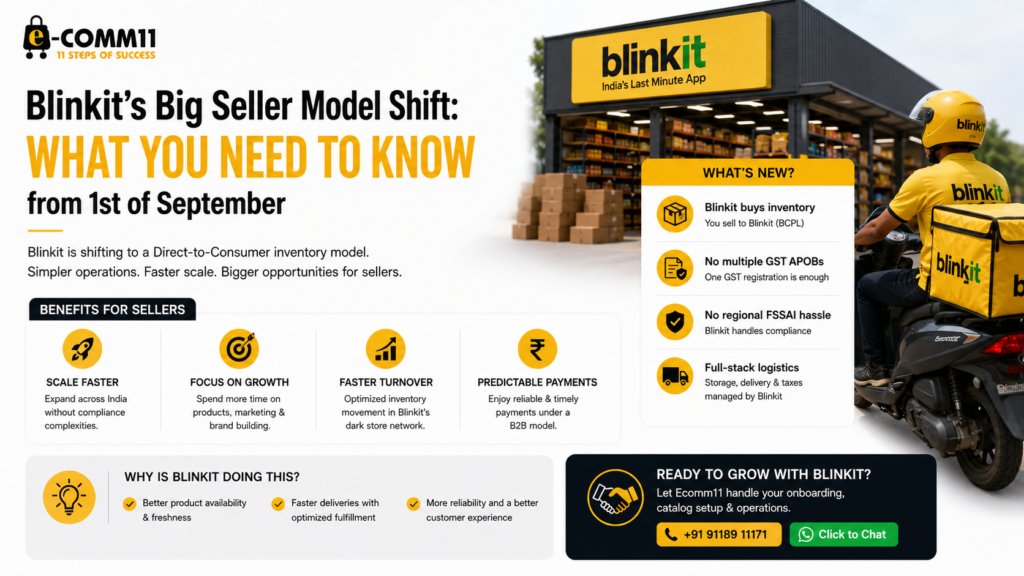
India’s leading quick commerce platform, Blinkit (a Zomato-owned company), is redefining its relationship with sellers—and it’s a game-changer for brands, especially small and mid-sized businesses looking to scale efficiently. Starting September 1, Blinkit will shift to a Direct-to-Consumer (D2C) inventory model, taking control of stock ownership, tax compliance, and logistics. This move is designed to simplify operations and boost efficiency across its network of dark stores.
What’s Changing?
Previously, Blinkit functioned as a marketplace, enabling sellers to list products while maintaining their own inventory in Blinkit’s dark stores. Sellers were responsible for:
- Maintaining multiple APOBs (Additional Places of Business) under GST for each state.
- Securing FSSAI licenses separately for each region where their inventory was stored.
- Handling compliance, logistics, and taxes across state lines.
This was especially cumbersome for emerging brands that were scaling up their distribution across India.
The New Model: Blinkit as the Merchant of Record
Under the updated model, Blinkit will directly purchase inventory from sellers and sell it to customers as the primary merchant. Here’s what this means for sellers:
- No need for multiple GST APOBs – Sellers can operate with just one GST registration, regardless of how many cities Blinkit serves their products in.
- No regional FSSAI hassle – Blinkit takes over the responsibility for food safety licensing and compliance.
- Inventory transferred – Products will be moved from the seller’s books to Blink Commerce Private Limited (BCPL), Blinkit’s legal entity.
- Full-stack logistics handled – Storage, last-mile delivery, and all downstream taxation are managed by Blinkit.
Benefits for Sellers
This transition significantly eases the burden for sellers, especially small and D2C brands, by allowing them to:
- Scale across India faster without worrying about bureaucratic red tape.
- Focus more on product innovation and marketing rather than logistics and compliance.
- Gain from faster inventory turnover as Blinkit optimizes stock movement inside its ultra-fast dark store network.
- Enjoy predictable payments under a B2B procurement model.
Why Is Blinkit Doing This?
This strategic change aligns with Blinkit’s broader mission to build the fastest and most reliable quick commerce network in India. By controlling inventory and delivery timelines end-to-end, Blinkit can:
- Offer customers greater product availability and freshness.
- Reduce delivery times further by optimizing fulfillment from its micro-warehouses.
- Eliminate delays caused by seller-side mismanagement or documentation errors.
- Enhance customer experience while simplifying partner engagement.
What Sellers Should Do Next
If you’re a seller on Blinkit or planning to join the platform, here’s how to prepare:
- Ensure your supply chain is ready for B2B transfers.
- Coordinate with Blinkit’s seller support to streamline inventory transfer.
- Update your compliance documentation to match the new model.
- Prepare for potential volume-based deals as Blinkit becomes your direct customer.
Final Word
Blinkit’s decision to become the merchant of record is a bold step toward modernizing quick commerce in India. This shift allows sellers to focus on what matters most—building great products and reaching more customers—while Blinkit takes care of everything else, from compliance to delivery.
Need Help Managing Blinkit Operations?
At Ecomm11, we help brands simplify onboarding, catalog setup, and operational support for platforms like Blinkit, Zepto, Amazon, Flipkart, and more.
📞 Call us: +91 91189 11171
💬 WhatsApp: Click to Chat