
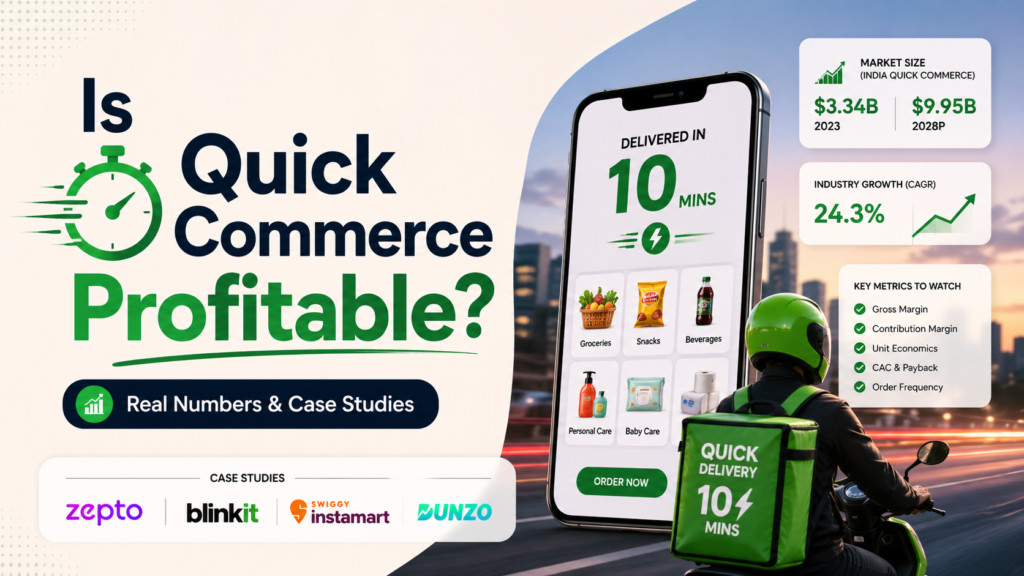
Quick commerce has taken the retail world by storm. From groceries delivered in 10 minutes to instant access to daily essentials, the model has seen explosive growth—especially in urban markets. But one question continues to dominate industry discussions: Is quick commerce actually profitable?
In this blog, we’ll break down the real numbers, explore case studies of leading companies, and uncover whether quick commerce is a sustainable business model or just a high-growth, high-burn industry.
What is Quick Commerce?
Quick commerce (q-commerce) is an evolution of eCommerce that focuses on ultra-fast delivery—typically within 10 to 30 minutes. It relies on:
- Dark stores (micro-warehouses)
- Hyperlocal logistics
- High-frequency, low-value orders
While the convenience is unmatched, the economics behind it are far more complex.
The Big Question: Is Quick Commerce Profitable?
Short Answer:
Not yet at scale—but moving toward profitability.
Most quick commerce companies today are still loss-making, even though their revenues are growing rapidly. The industry is currently in a “grow first, profit later” phase.
Real Numbers Behind Quick Commerce
Let’s look at actual data from leading players to understand the financial reality.
1. High Revenue Growth, But Losses Continue
- Blinkit reported 155% year-on-year revenue growth, reaching around ₹2,400 crore in a quarter
- Despite this, it posted operating losses of ₹162 crore
Similarly:
- Swiggy Instamart grew revenue by over 100%, but losses widened significantly to ₹896 crore
👉 Insight: Growth is strong, but profitability is lagging behind.
2. Industry-Wide Cash Burn
Quick commerce companies are spending heavily on:
- Delivery infrastructure
- Dark store expansion
- Customer acquisition
For example:
- Companies are investing thousands of crores in expanding dark store networks
- One report showed ₹1,038 crore spent in a single quarter on expansion alone
👉 Insight: Scaling the business requires massive upfront investment.
3. Average Order Value vs Cost
- Typical order values range between ₹350 to ₹650
- But costs include:
- Picking & packing
- Delivery rider fees
- Discounts and promotions
👉 This creates a thin margin structure, making profitability difficult.
4. Market Growth is Exploding
- India’s quick commerce market is projected to grow rapidly and may triple by 2028
- The top three players control the majority of the market:
- Blinkit (~44–46%)
- Zepto (~29–30%)
- Instamart (~23–25%)
👉 Insight: The opportunity is huge—but competition is intense.
Case Study 1: Blinkit (Zomato)
Blinkit is currently the market leader in India’s quick commerce space.
What’s Working:
- Strong market share
- Rapid revenue growth
- Integration with Zomato ecosystem
Profitability Status:
- Moving toward EBITDA breakeven
- Still dealing with high operational costs
Key Strategy:
- Increasing average order value
- Expanding dark stores
- Improving unit economics
👉 Blinkit shows that scale + efficiency can lead to profitability, but it takes time.
Case Study 2: Zepto
Zepto is one of the fastest-growing quick commerce startups.
What’s Working:
- Aggressive expansion
- Strong investor backing
- Focus on urban markets
Profitability Status:
- Still loss-making
- Targeting profitability by FY29
Key Strategy:
- Reducing cash burn
- Improving operational efficiency
- Preparing for IPO
👉 Zepto highlights how startups are prioritizing growth first, profits later.
Case Study 3: Swiggy Instamart
Instamart is Swiggy’s quick commerce arm.
What’s Working:
- Strong brand and customer base
- Integration with food delivery
Profitability Status:
- Losses are still high
- Contribution margins are negative
Key Strategy:
- Slowing expansion
- Focusing on unit economics
👉 Instamart represents a shift toward sustainable growth over aggressive scaling.
Why Quick Commerce Struggles With Profitability
1. High Last-Mile Delivery Costs
Delivering orders within minutes requires:
- More riders
- Faster logistics
- Higher operational expenses
2. Low Margins on Products
Most quick commerce platforms sell groceries and essentials, which have:
- Low profit margins
- High competition
3. Heavy Discounts & Offers
To attract customers, companies rely on:
- Discounts
- Free delivery
- Cashback offers
These reduce profitability significantly.
4. Expensive Infrastructure
Dark stores, inventory management, and logistics systems require:
- High capital investment
- Ongoing maintenance costs
How Quick Commerce Companies Make Money
Despite challenges, companies are building multiple revenue streams:
1. Product Margins
Earnings from selling goods directly
2. Delivery Fees
Charges for instant delivery
3. Platform Fees
Convenience fees added to orders
4. Advertising Revenue
- Platforms like Blinkit and Zepto are generating ₹1,000+ crore annually from ads
👉 Ads are becoming a high-margin revenue stream, improving profitability potential.
Signs That Profitability is Improving
The industry is slowly moving toward profitability due to:
Reduced Discounts
Companies are cutting back on unsustainable offers
Higher Prices
Some platforms have started increasing prices slightly
Better Unit Economics
Improved logistics and inventory management
Focus on Efficiency
Shift from growth-at-all-costs to sustainable operations
The Future: Will Quick Commerce Become Profitable?
Yes—but with conditions.
Quick commerce can become profitable if companies:
- Increase average order value
- Optimize delivery routes
- Reduce operational costs
- Build high-margin revenue streams (like ads)
The industry is evolving from a growth phase to a profitability phase.
Final Verdict
So, is quick commerce profitable?
👉 Right now: Mostly no
👉 In the future: Likely yes
Quick commerce is still in its early stages, similar to how eCommerce was a decade ago. Companies are investing heavily to build infrastructure, acquire customers, and dominate the market.
Profitability will come—but only for those who can balance speed, scale, and sustainable economics.
Final Thoughts
Quick commerce is not just a trend—it’s a fundamental shift in consumer behavior. While profitability remains a challenge today, the long-term potential is undeniable.
For entrepreneurs and businesses, the key takeaway is clear:
Success in quick commerce depends not just on speed, but on smart economics.