
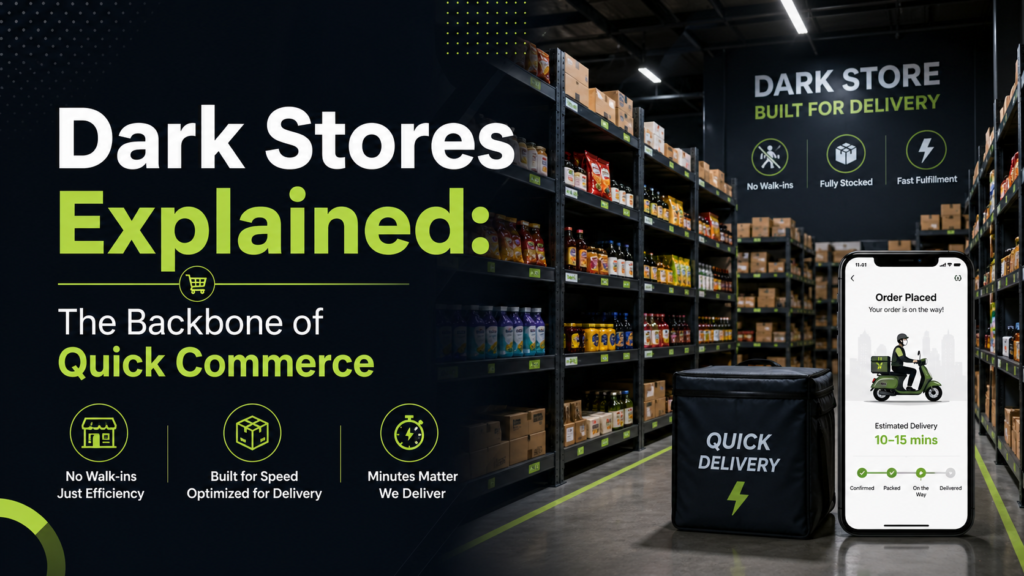
The rapid rise of quick commerce has transformed how consumers shop for everyday essentials. Today, people expect groceries, medicines, and daily-use items to be delivered within minutes rather than hours or days. Behind this lightning-fast delivery lies a powerful operational model known as dark stores.
Dark stores are the silent engines driving the quick commerce revolution. While customers interact with sleek mobile apps and seamless checkout systems, these hidden fulfillment centers ensure that orders are picked, packed, and dispatched at incredible speed.
In this blog, we’ll break down what dark stores are, how they work, and why they are essential for the success of quick commerce businesses.
What Are Dark Stores?
Dark stores are small, strategically located warehouses or retail outlets that are not open to the public. Unlike traditional stores, they operate exclusively to fulfill online orders.
These spaces are designed for efficiency rather than customer experience. There are no shelves for browsing customers, no billing counters for walk-ins, and no in-store marketing displays. Instead, everything is optimized for speed and accuracy.
Dark stores are typically located in high-demand urban areas to ensure that deliveries can be completed within 10 to 30 minutes.
Why Dark Stores Matter in Quick Commerce
Quick commerce depends on speed, and speed depends on proximity. Dark stores make it possible to store inventory close to customers, reducing delivery time significantly.
Key reasons why dark stores are essential:
- Faster order fulfillment: Products are picked and packed within minutes
- Reduced delivery distance: Locations are chosen based on demand density
- Improved efficiency: Operations are streamlined for online orders only
- Better inventory control: Focused product range based on local demand
Without dark stores, achieving ultra-fast delivery would be nearly impossible.
How Dark Stores Work
Dark stores operate on a highly optimized workflow that prioritizes speed and accuracy.
Step-by-step process:
- Order Placement
A customer places an order through a quick commerce app. - Order Allocation
The system assigns the order to the nearest dark store. - Picking Process
Store staff quickly locate and pick items from shelves. - Packing
Items are packed efficiently, often within minutes. - Dispatch
A delivery partner is assigned, and the order is sent out. - Delivery
The order reaches the customer within a short time frame.
This entire process is powered by advanced technology, including real-time inventory systems and route optimization tools.
Key Features of a Successful Dark Store
Not all dark stores are created equal. To perform efficiently, they must include certain critical elements.
1. Strategic Location
Dark stores are placed in densely populated areas to ensure quick access to customers. The closer the store is to the consumer, the faster the delivery.
2. Optimized Layout
The internal layout is designed for speed. High-demand items are placed in easily accessible areas to reduce picking time.
3. Limited but Relevant Inventory
Unlike supermarkets, dark stores focus on a curated selection of fast-moving products. This ensures:
- Faster picking
- Better stock turnover
- Reduced storage complexity
4. Technology Integration
Modern dark stores rely heavily on technology, including:
- Real-time inventory tracking
- Automated order management systems
- Demand forecasting tools
5. Skilled Workforce
Staff are trained specifically for fast picking and packing. Efficiency is key, and every second matters.
Dark Stores vs Traditional Warehouses
While both store inventory, dark stores and traditional warehouses serve different purposes.
| Feature | Dark Stores | Traditional Warehouses |
|---|---|---|
| Location | Urban, near customers | Outskirts or industrial areas |
| Purpose | Quick order fulfillment | Bulk storage and distribution |
| Speed | Ultra-fast (minutes) | Slower (hours to days) |
| Inventory | Limited, high-demand items | Large and diverse inventory |
| Accessibility | Not open to public | Not customer-facing |
Dark stores are built for speed, while warehouses are built for scale.
Benefits of Dark Stores for Businesses
Dark stores offer several advantages that make them ideal for quick commerce operations.
Faster Deliveries
By reducing the distance between inventory and customers, businesses can fulfill orders quickly.
Lower Operational Costs
Smaller spaces and focused inventory reduce overhead costs compared to large retail stores.
Higher Order Accuracy
Optimized systems and trained staff reduce errors in picking and packing.
Scalability
Businesses can easily expand by adding more dark stores in new locations.
Challenges of Dark Stores
Despite their advantages, dark stores come with their own set of challenges.
High Setup Costs
Setting up multiple locations in urban areas can be expensive.
Inventory Management
Maintaining the right stock levels across multiple stores requires precise forecasting.
Demand Fluctuations
Sudden spikes in demand can lead to stockouts or delays.
Operational Complexity
Managing multiple dark stores simultaneously requires strong coordination and technology.
The Role of Dark Stores in Customer Experience
While customers never visit a dark store, its efficiency directly impacts their experience.
A well-run dark store ensures:
- Faster deliveries
- Accurate orders
- Fresh products
- Reliable service
In quick commerce, customer satisfaction is closely tied to backend operations, making dark stores a critical component.
Future of Dark Stores
As quick commerce continues to grow, dark stores are evolving rapidly.
Emerging trends include:
- Micro-fulfillment centers: Smaller, more automated stores
- AI-driven inventory management: Predicting demand more accurately
- Automation and robotics: Faster picking and packing
- Sustainable operations: Energy-efficient storage and delivery
These innovations will further enhance speed, efficiency, and scalability.
Final Thoughts
Dark stores may not be visible to customers, but they are the backbone of quick commerce. They enable businesses to meet the growing demand for instant delivery while maintaining efficiency and accuracy.
As competition in the quick commerce space intensifies, investing in well-planned and technologically advanced dark stores will be key to success.
For businesses looking to thrive in this fast-paced industry, understanding and optimizing dark store operations is no longer optional—it’s essential.