
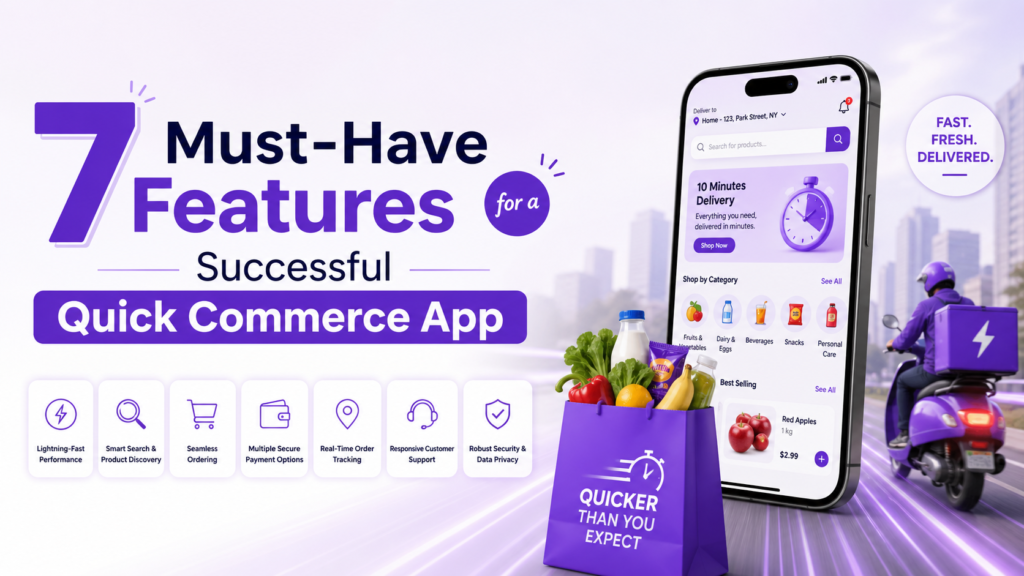
Quick commerce is redefining the way consumers shop online. With delivery expectations shrinking from days to minutes, businesses are under pressure to build apps that are not only fast but also highly efficient, intuitive, and reliable. In today’s competitive landscape, simply having an app is not enough—you need the right features to meet customer expectations and stand out.
In this blog, we’ll explore the 7 must-have features for a successful quick commerce app and why they matter for growth, retention, and customer satisfaction.
What is Quick Commerce?
Quick commerce, often referred to as q-commerce, focuses on ultra-fast delivery—typically within 10 to 30 minutes. It relies on hyperlocal logistics, dark stores, and optimized supply chains to deliver essentials like groceries, medicines, and daily-use items almost instantly.
For businesses, success in this space depends heavily on technology, especially mobile apps that act as the primary customer touchpoint.
Why Features Matter in Quick Commerce Apps
In quick commerce, speed alone isn’t enough. Customers expect:
- Seamless navigation
- Real-time updates
- Personalized experiences
- Reliable delivery
The right features ensure that your app delivers on all these expectations while also optimizing backend operations.
1. Real-Time Inventory Management
One of the biggest challenges in quick commerce is inventory accuracy. Showing items that are out of stock leads to frustration and abandoned carts.
Why it matters:
- Prevents order cancellations
- Builds trust with customers
- Improves operational efficiency
What to include:
- Live stock updates
- Auto-sync with warehouse/dark store
- Smart alerts for low inventory
A robust inventory system ensures that customers only see what’s actually available nearby.
2. Ultra-Fast Checkout Process
In quick commerce, every second counts. A complicated checkout process can drive users away.
Key elements:
- One-click checkout
- Saved addresses and payment methods
- Minimal form filling
Benefits:
- Reduces cart abandonment
- Enhances user experience
- Speeds up order placement
The goal is to make the journey from product selection to order confirmation as smooth and fast as possible.
3. Real-Time Order Tracking
Customers want to know exactly where their order is at any given moment. Real-time tracking is no longer optional—it’s expected.
Features to include:
- Live delivery tracking on map
- Order status updates (packed, out for delivery, delivered)
- Estimated delivery time
Why it’s important:
- Builds transparency
- Reduces customer anxiety
- Improves overall experience
This feature plays a crucial role in customer satisfaction and retention.
4. Smart Search and Product Discovery
With a wide range of products, users need to find what they’re looking for quickly.
Must-have capabilities:
- Predictive search suggestions
- Voice search (optional but trending)
- Filters and categories
- Recently ordered items
Impact:
- Saves time for users
- Increases conversions
- Encourages repeat purchases
A powerful search function ensures users don’t leave your app due to frustration.
5. Personalized Recommendations
Personalization is a game-changer in eCommerce and even more so in quick commerce.
How it works:
- Suggest products based on past purchases
- Highlight frequently bought items
- Offer tailored discounts
Benefits:
- Boosts average order value
- Enhances user engagement
- Creates a more relevant shopping experience
Customers are more likely to buy when the app feels tailored to their needs.
6. Multiple Payment Options
Flexibility in payments is essential for a smooth checkout experience.
Include options like:
- Credit/debit cards
- UPI and digital wallets
- Cash on delivery (if applicable)
- Buy Now, Pay Later (BNPL)
Why it matters:
- Caters to diverse user preferences
- Reduces payment drop-offs
- Builds convenience and trust
A lack of preferred payment options can lead to lost sales, so this feature is critical.
7. Efficient Delivery Management System
The backbone of any quick commerce app is its delivery system.
Key components:
- Route optimization
- Delivery partner allocation
- Real-time tracking integration
- Delivery time prediction
Benefits:
- Ensures faster deliveries
- Reduces operational costs
- Improves delivery accuracy
An efficient delivery system directly impacts customer satisfaction and repeat usage.
Bonus Features to Consider
While the above seven features are essential, adding these can give you a competitive edge:
Push Notifications
- Order updates
- Flash sales and offers
- Cart reminders
Customer Support Integration
- Live chat or chatbot
- Easy complaint resolution
- FAQ section
Ratings and Reviews
- Builds trust
- Helps customers make decisions
- Improves product quality through feedback
Challenges in Building a Quick Commerce App
Even with the right features, businesses face challenges such as:
- High operational costs
- Maintaining delivery speed
- Managing supply chain efficiently
- Handling peak demand
Addressing these challenges requires strong backend systems and continuous optimization.
Future of Quick Commerce Apps
The future of quick commerce is driven by innovation. Emerging trends include:
- AI-powered demand forecasting
- Drone and autonomous deliveries
- Hyper-personalization
- Dark store expansion
Apps that adapt to these trends will have a clear advantage in the market.
Final Thoughts
Building a successful quick commerce app is not just about speed—it’s about delivering a seamless, reliable, and personalized experience. The features discussed above form the foundation of any high-performing app in this space.
By focusing on real-time operations, user convenience, and efficient logistics, businesses can not only meet but exceed customer expectations.
In a world where convenience is king, the right app features can make all the difference between a one-time user and a loyal customer.