
Introduction
The quick commerce industry is growing rapidly, and platforms like Blinkit have transformed how businesses manage orders, deliveries, and customer expectations. However, with faster order processing comes a greater need for automated invoicing and GST compliance. In 2026, IRN generation and E-Invoice API integration have become essential for Blinkit sellers handling large transaction volumes and maintaining regulatory compliance.
Manual invoicing methods often lead to delays, data mismatches, and compliance risks. To solve these challenges, businesses are increasingly adopting E-Invoice APIs that automate invoice generation, validation, and reporting directly through the Invoice Registration Portal (IRP).
This guide explains how IRN and E-Invoice APIs work, why they matter for Blinkit sellers, and how businesses can integrate them efficiently to achieve faster, error-free invoicing.
Understanding IRN and E-Invoice API in 2026
India’s e-invoicing ecosystem has become more advanced, secure, and technology-driven in 2026.
The Invoice Reference Number (IRN) is a unique hash generated when invoice data is submitted to the Invoice Registration Portal (IRP). This number verifies invoice authenticity and ensures proper GST compliance.
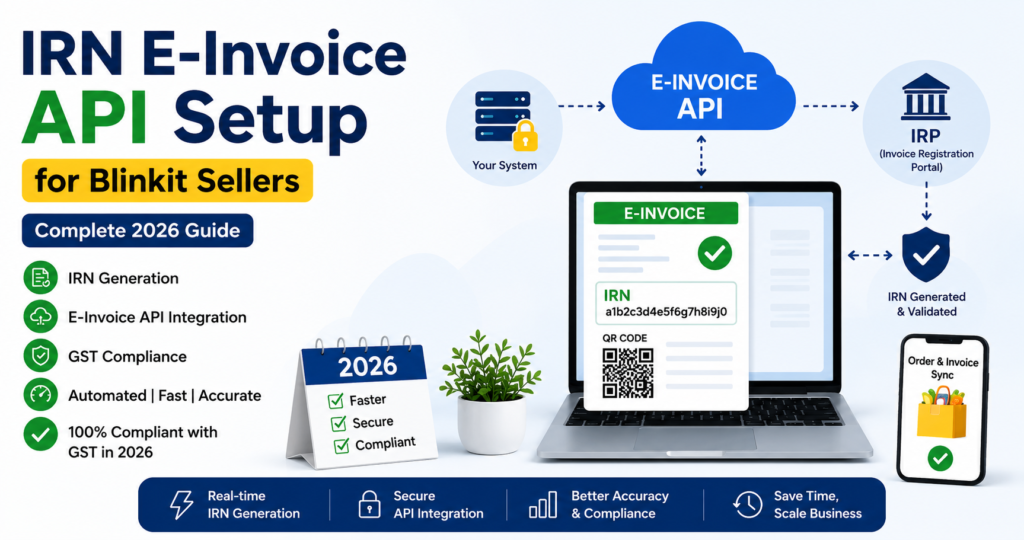
An E-Invoice API acts as a bridge between your invoicing system and the IRP, enabling businesses to send invoice data automatically and receive validated responses instantly.
Modern E-Invoicing Systems Now Support:
✔ Faster validation
✔ Better uptime
✔ Improved schema accuracy
✔ Reduced processing delays
✔ Enhanced security
Compared to earlier systems, 2026 APIs now provide quicker responses and stronger fraud prevention.
For Blinkit sellers processing high-volume orders, automation ensures that invoicing remains accurate and aligned with operational speed.
👉 Automated invoicing improves both compliance and business efficiency.
Why IRN and API Integration Matter More Than Ever
With stricter GST regulations and real-time compliance monitoring, API-based IRN generation is no longer optional for many businesses.
Manual invoicing creates several challenges:
✔ Human errors
✔ Invoice mismatches
✔ Delayed reporting
✔ Compliance penalties
✔ Operational inefficiencies
E-Invoice APIs solve these problems by creating a seamless connection between business systems and government portals.
Major Benefits Include:
✔ Real-time invoice validation
✔ Faster GST reconciliation
✔ Better transparency
✔ Reduced fraud risk
✔ Improved reporting accuracy
Government systems introduced in 2026 rely heavily on digitally signed invoices and IRN validation to maintain authenticity.
For Blinkit sellers, where speed is critical, API integration ensures invoices match orders without delays.
👉 Businesses using automated IRN systems remain audit-ready and operationally efficient.
Updated Compliance and Technical Requirements in 2026
Before integrating E-Invoice APIs, businesses must meet updated compliance and infrastructure requirements.
GST Compliance Requirements
Businesses must maintain:
✔ Active GST registration
✔ Updated GST returns
✔ Valid business information
✔ IRP access eligibility
Failure to maintain updated GST records may interrupt API functionality.
API Credentials and Security Setup
Authorized API access requires secure credential generation.
Required Credentials Include:
✔ Client ID
✔ Secret keys
✔ Authentication credentials
✔ Secure API access permissions
Security requirements have become stricter in 2026.
Updated Security Standards
✔ IP whitelisting
✔ HTTPS encryption
✔ Token-based authentication
✔ Secure server environments
Depending on invoicing structure, some businesses may also require updated Digital Signature Certificates (DSC).
Technical Infrastructure Requirements
Systems should support:
✔ REST APIs
✔ JSON data format
✔ HTTPS communication
✔ Cloud-ready environments
Cloud-based systems are increasingly recommended due to:
✔ Better uptime
✔ Scalability
✔ Faster processing
👉 Proper preparation reduces integration failures and ensures smoother API performance.
Step-by-Step IRN E-Invoice API Setup for Blinkit Sellers
Implementing E-Invoice APIs requires a structured approach.
Step 1: Register and Obtain API Access
Businesses must first register through authorized GST systems or certified providers.
This process involves:
✔ Eligibility verification
✔ API registration
✔ Credential generation
Once approved, access credentials are issued.
Step 2: Configure Secure Environment
A secure environment is essential for stable API communication.
Configuration Includes:
✔ SSL setup
✔ Firewall configuration
✔ Secure endpoints
✔ Access controls
Strong infrastructure protects invoice data and prevents interruptions.
Step 3: Prepare Invoice Data
Invoice information must follow the latest schema standards.
Required Information Includes:
✔ GSTIN details
✔ Invoice number
✔ Buyer information
✔ Tax amounts
✔ Product details
Pre-validation helps reduce errors before submission.
Step 4: Authenticate and Generate Session Token
Authentication uses API credentials to generate session tokens.
Proper token management avoids:
✔ Expired sessions
✔ Authentication failures
✔ Workflow interruptions
Automated token refresh systems are increasingly used in 2026.
Step 5: Submit Invoice to IRP
Once authenticated:
✔ Invoice data is transmitted
✔ IRP validates information
✔ Response is generated
Successful submissions return:
✔ IRN
✔ Digitally signed invoice
✔ QR code
These responses should be stored securely.
Step 6: Sync With Blinkit Workflow
Final integration connects invoicing with Blinkit operations.
Workflow Integration Includes:
✔ Order processing
✔ Billing
✔ Inventory updates
✔ Reporting systems
Typical Process Flow
Order Received → Invoice Created → API Submission → IRN Generated → QR Code Issued → Blinkit System Sync
👉 End-to-end integration improves speed and accuracy.
How Blinkit Sellers Benefit From API Automation
Blinkit sellers operate in a fast-moving environment where delays directly affect fulfillment and customer satisfaction.
E-Invoice API automation creates measurable operational advantages.
Key Benefits Include
1. Faster Invoice Generation
Invoices are validated instantly, reducing manual workload and improving fulfillment speed.
2. Reduced Human Errors
Automation eliminates common mistakes such as:
✔ Wrong GST values
✔ Missing fields
✔ Duplicate invoices
3. Better GST Compliance
Real-time reporting keeps businesses aligned with tax requirements.
4. Improved Financial Visibility
Automated synchronization provides:
✔ Better tracking
✔ Faster reconciliation
✔ Clear transaction history
5. Stronger Security
Digitally signed invoices protect against:
✔ Tampering
✔ Fraud
✔ Unauthorized edits
👉 API automation supports both compliance and scalability.
Common API Errors in 2026 and How to Fix Them
Although systems have improved, businesses may still encounter integration issues.
1. Authentication Errors
Usually caused by:
✔ Wrong credentials
✔ Expired tokens
Solution:
Use automated token refresh systems.
2. Validation Errors
These occur when:
✔ Mandatory fields are missing
✔ Data format is incorrect
Solution:
Validate invoices before submission.
3. Timeout and Network Errors
Possible causes include:
✔ Firewall restrictions
✔ Slow connections
✔ Endpoint interruptions
Solution:
Configure retry logic and optimize networking.
4. Duplicate Invoice Errors
Repeated invoice submissions may create duplication.
Solution:
✔ Unique invoice numbers
✔ Idempotency controls
5. Temporary IRP Downtime
Though less frequent, downtime may still occur.
Solution:
✔ Queue-based fallback systems
✔ Delayed submission workflows
👉 Proactive monitoring ensures smoother invoicing operations.
Future of E-Invoicing for Quick Commerce Businesses
The e-invoicing ecosystem is expected to evolve further beyond 2026.
Emerging technologies may include:
✔ AI-powered validation
✔ Predictive compliance monitoring
✔ Smart fraud detection
✔ Real-time analytics dashboards
✔ Automated tax reconciliation
Quick commerce businesses like Blinkit will increasingly depend on these innovations to maintain operational speed and transparency.
Businesses investing in scalable infrastructure today will adapt more easily to future regulations and marketplace demands.
👉 E-invoicing is rapidly becoming the backbone of digital commerce compliance.
Frequently Asked Questions (FAQs)
What is IRN?
IRN is a unique reference number generated when an invoice is validated through the Invoice Registration Portal.
Is E-Invoice mandatory for Blinkit sellers?
Eligibility depends on GST turnover and applicable government rules.
How long does IRN generation take?
API-based IRN generation usually takes only a few seconds.
What happens if invoice validation fails?
The invoice is rejected until errors are corrected and resubmitted.
Can an IRN be cancelled?
Yes, cancellation is allowed within specified GST timelines.
Final Thoughts
In 2026, IRN generation and E-Invoice API integration are no longer optional tools—they are critical systems for compliance and operational efficiency.
For Blinkit sellers managing fast-moving orders and large invoice volumes, automation delivers:
✔ Faster invoicing
✔ Better compliance
✔ Reduced errors
✔ Improved workflow efficiency
Businesses that adopt reliable E-Invoice API systems and scalable infrastructure will remain competitive and future-ready.
Need Help With IRN or E-Invoice API Integration?
From API setup and GST compliance to seamless Blinkit workflow integration, expert support can simplify invoicing and help businesses operate faster and smarter.
Success in quick commerce now depends on automation, compliance, and seamless digital operations.